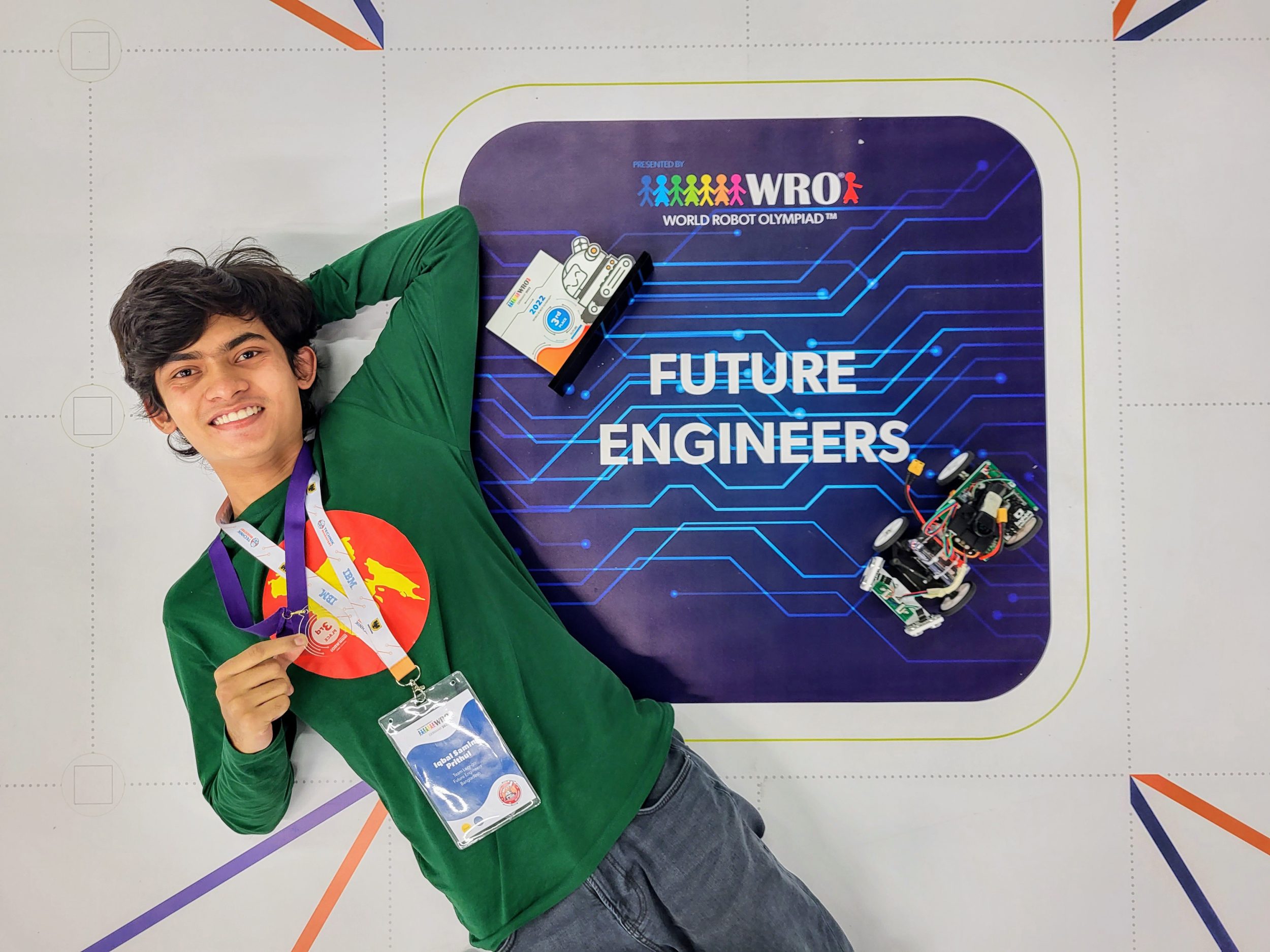
A robot that wasn’t ready, a team started from scratch twice, and last-minute visa issues — how a builder from Bangladesh made it to a World Robot Olympiad podium in Germany, and what happened after.
When Iqbal Samin Prithul was a kid in Jashore, Bangladesh, he took apart electronic devices to see how they worked, collected motors and components, and saved money to buy parts from a nearby electronics shop. The shopkeeper sold him parts; Prithul figured out what they could do. Then, after moving to Dhaka for university, he saw a Facebook post for the World Robot Olympiad™ (WRO®) national competition just a week later. He had no idea at the time that the post would lead him to an international podium — and become part of a journey that would later take him to the US and Europe.
Building from scrap
Prithul’s mother encouraged his interest in computers, and convinced his dad they should buy him a computer in early sixth grade. He didn’t have internet until eighth grade, but he got hold of a Bengali-language book on C programming, and by copying what was written in the PDF, he taught himself how to code.
Internet access around eighth grade accelerated everything: he could finally watch online tutorials, reproduce other people’s projects and modify them. One of the first things he built was a little CNC machine that would use a pen to draw on a card.
“I was building everything with plywood which is really hard, so for a long time I wanted to build my own 3D printer, this mind-blowing technology that lets you build anything with plastic,” Prithul says.
So, during COVID and after collecting parts for a year, he built a 3D printer, using second-hand components and motors salvaged from old photocopiers. For years, building was something he did on his own, and building from scrap shaped a lasting habit.
“If something is missing, I don’t automatically go, ‘I have to buy it,'” he says. “I always think of ways to use something else in the same place.”
Nothing to lose
Despite the short notice, the 2022 WRO nationals immediately caught Prithul’s attention. The WRO category Future Engineers involved an autonomous vehicle, and he already had a radio controlled, 3D-printed vehicle that he had built himself. The competition required a team of at least two people. So he contacted someone he knew through Facebook but had never met. Prithul was stronger in hardware; the other student was stronger in software. They decided to join together, and adapt the robot to fit competition requirements. It still wasn’t fully ready on the morning of the competition, but they went anyway.
“I thought, I have nothing to lose, so I might as well try,” Prithul says.
A week later, Prithul and the teammate he had never met before entering the competition won the national round. They qualified to represent Bangladesh at the WRO International Final in Germany – a massive event featuring four competition categories and 365 teams from 73 countries. Getting the robot ready in one month was the least of their problems.
A steep learning curve
Because of high-school exams, Prithul’s teammate couldn’t travel to Germany. Instead, Prithul was paired with a member of the team that had finished second nationally, and also had a team member who couldn’t make it. It was not a plug-and-play partnership.
Both were stronger in hardware than software and had very different approaches. Sometimes they would meet to work on the vehicle, clash and simply go home. Eventually, Prithul realised he was trying to solve the wrong problem.
“There was a point we were so away from each other that I realised, this is not working,” he recalls. “Instead of how to make the robot work, how do we work together?”
They went to a restaurant and agreed not to talk about the robot.
“We’re just going to eat this food and get to know each other, because I don’t even know who you are, really.”
That helped. But even with better teamwork and the robot ready, they still had no idea if they would make it to Germany.
The visas that weren’t there
Their collaboration went more smoothly after that. The next big issue was severely delayed visa processing. With no funding, which is a common problem in Bangladesh according to Prithul, the team had paid for everything themselves – the robot, flights and accommodation – without knowing if they would get visas in time. Many visa office visits later, they were finally told that they could collect their visas the day before their flight. They showed up at the office on time, but the visas weren’t there.
Prithul’s mantra of “what do we have to lose?” kept him going: he and some of the other participants who qualified for the international final started calling and emailing embassy contacts. They even tried the German ambassador on X. Finally, someone from the embassy side called them back. Flights were changed to the next day, and this time, the visas were ready.
Three times stuck
During practice in Dortmund, their robot sometimes got caught against the walls at an angle. The same thing happened during the competition. Rules state that you have one try to solve an issue – if your robot gets stuck after that, you lose the run. Late on the second day, Prithul had an idea for a last-minute code fix: if the robot got stuck, the wheels would briefly run at full power, pushing it free. The code was tested immediately. In their final run that day, the robot got stuck three times. And every time, the code got it moving again.
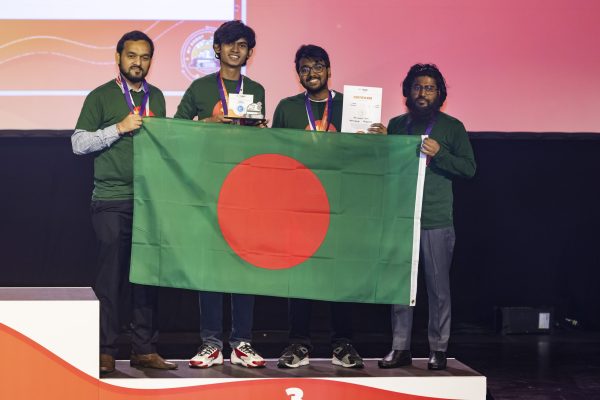
At the closing ceremony, Prithul did not expect a medal. Their National Organizer told the small Bangladesh delegation to keep the flag ready anyway. Prithul was looking at teams from other countries going up on the stage and remembers thinking, ‘why bother.’
“But they called our name and we ran up there, and I was glad I had the flag in my hand, and it was just surreal,” he says. “I didn’t realize it was happening.” He is smiling and shaking his head, like he still has trouble believing it happened.
“It’s helped in every way possible”
He didn’t understand the importance of winning at the time. But when the team got called for a TV interview, it started to feel like success. WRO went onto his CV. In later job and scholarship interviews, it gave people something concrete to ask about: competing internationally, the team-building skills, and solving problems on the spot.
“One thing led to another. It’s helped in every way possible for me,” he says.
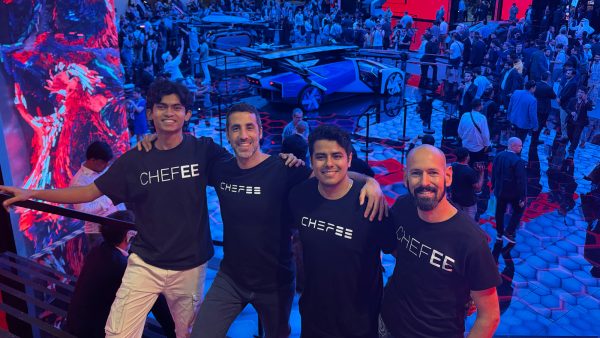
Before Dortmund, Prithul had done small freelance assignments for the US start-up Chefee Robotics. After Germany, the company saw the potential in him and offered him a part-time remote position. Prithul later applied for and received a US government scholarship to study in the US. After a year there, he moved on to a fully funded Hungarian government scholarship. Today, he studies electrical engineering in Budapest.
After ageing out as a participant, Prithul returned to WRO Bangladesh as a Future Engineers judge and helped with Bengali-language sessions explaining the competition and its rules. When the category’s age limit later changed, he became eligible again, and returned as a participant at the 2025 International Final in Singapore.
Still building
Studying and working in the United States helped Prithul realise that he wanted to work hands-on with physical products. He wants to create a bridge between mechanical engineering and electrical engineering to create the best possible products.
To underline his point, he is currently building a specialized 3D printer for a client alongside his studies.
“I’m doing it because I enjoy it,” he says. “And it’s what I want to do in the future.”
The parts, place and purpose have changed. His instinct to build has not.
Profile
Name and age: Iqbal Samin Prithul, 23
Role in WRO: Future Engineers participant for Bangladesh; third place at the WRO International Final in Dortmund in 2022; later Future Engineers judge in Bangladesh; returned as a participant at the 2025 International Final in Singapore.
University: Budapest University of Technology and Economics, Budapest, Hungary – studying electrical engineering on Stipendium Hungaricum, a fully funded Hungarian government scholarship.
Standout: Spent a year during COVID collecting second-hand parts, including motors salvaged from old photocopiers, to build his first 3D printer.